SAMS news room
MP discovers SAMS' Greenland credentials
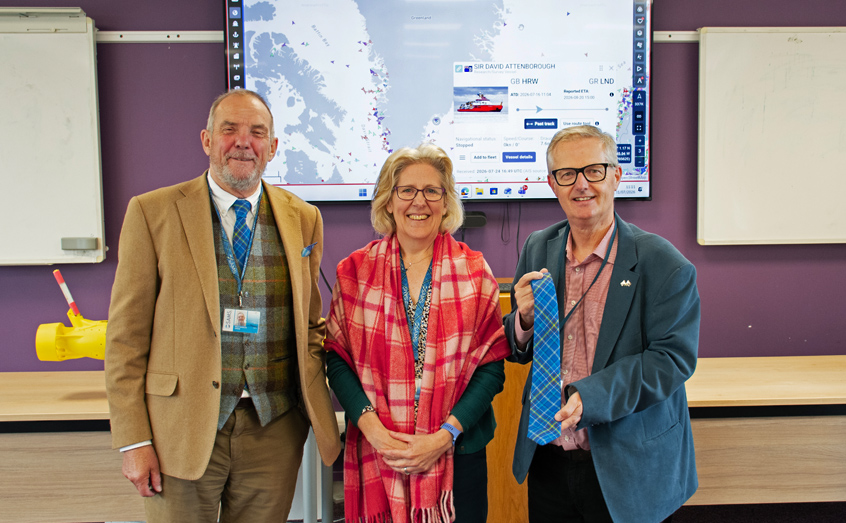
A UK politician with close ties to Greenland has praised the work of SAMS scientists in and around the Arctic nation after meeting researchers on a fact-finding visit to the institute.
Brendan O’Hara leads the UK Parliament’s All Party Parliamentary Group on Greenland and has previously presented the nation with a specially commissioned tartan.
SAMS, a partner of the University of the Highlands and Islands (UHI), sits within Mr O’Hara’s Argyll and Bute constituency.
During the visit, the MP learned how SAMS scientists are using marine robotics and remote sensing to assess changes in Greenland glaciers. As part of the multi-million pound GIANT project, funded by the UK’s Advanced Research and Invention Agency (ARIA), SAMS researchers are currently investigating how a warming ocean is affecting Greenland’s ice sheet.
He also discovered how the retreating glaciers were allowing marine robots to map the seabed beneath Greenland’s glaciers for the first time, while a combination of remotely operated vehicle (ROV) footage and artificial intelligence was assessing the marine growth on the glacier wall below the ocean surface – another world first.
Dr Neil Fraser introduced the SCOTIA array, a series of oceanographic observations between Scotland and Canada, which is giving scientists the most comprehensive view yet of how large-scale north Atlantic currents that dictate our climate may be changing.
Mr O’Hara then heard about the opportunities for SAMS students to study in the Arctic at the University in Svalbard and about the work of SAMS’ writer-in-residence Mandy Haggith, who is currently penning her novel ‘A possible polar bear’, set on a boat in the pack ice in the Greenland Sea.
“It was a genuine pleasure for me to spend time with the scientists at SAMS, talking all things Arctic, with a particular focus on their work in Greenland,” said Mr O’Hara.
“Quite rightly, SAMS is regarded as one of the jewels in the crown of Scottish academia, and having travelled extensively across the Arctic in the past decade, I have seen the high regard in which SAMS is held within the international scientific community as well.
“For an amateur enthusiast such as me to have had the opportunity to meet with and hear at first hand, exactly what SAMS’ scientists are doing in terms of polar research was a real privilege, and I’m extremely grateful for them giving up so much of their time.”
The visit was organised by Prof. Elizabeth Cottier-Cook, SAMS Associate Director for Science and External Engagement, who explained that the amount of fresh water and organic carbon now being released from the Greenland ice sheet could have serious consequences for the climate and sea level rise globally and stressed the critical importance of the research being done by SAMS researchers in this area.
Addressing Mr O’Hara, she said: “We wanted you to know how much work SAMS is involved with in Greenland. There are a lot of projects underway benefiting from our wide range of expertise.
“We are not the biggest institute doing work there, but we punch well above our weight in terms of the incredible science we undertake.”

Euan Paterson
Communications and Media Officer
Euan.Paterson@sams.ac.uk
01631 559342 (direct dial)
07827 963984 (mobile)
01631 559000 (switchboard)