SAMS news room
ACES Stars: Mumtahina Mohammad
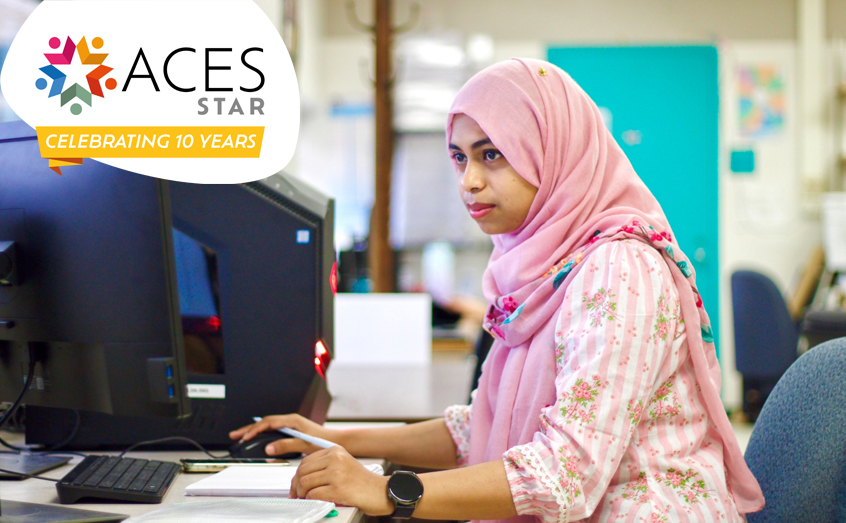
In our ACES Stars series, we meet alumni from our Erasmus Mundus Joint Masters Degree in AquaCulture, Environment and Society (ACES-STAR) and find out how the course helped to shape their careers.
ACES-STAR alumna Mumtahina Mohammad first became interested in aquaculture when, as a child, she saw a river dry up near to her home in Pabna, Bangladesh.
Seeing the impact on local livelihoods made her think about water pollution and conservation and inspired a research career that has seen her begin a PhD at Wayne State University, Michigan.
Mumtahina credits the Erasmus Mundus ACES-STAR programme with not only giving her a global knowledge on aquaculture, but also giving her the confidence to venture outside of her own country.
“I belong to a conservative family, and when I was a girl, I wouldn't have dared to go to another district within my country by myself,” she said. “Despite my family's encouragement to learn, I lacked the real-world experience to venture outside of my comfort zone. For me, ACES altered that.
“I became more self-assured, brave, and independent as a result of the training. It exposed me to different cultures, expanded my horizons academically, and provided me with the tools and encouragement I needed to succeed.
“Without ACES, I wouldn’t have had the confidence or opportunity to follow my passion for science and education abroad.”
While studying a zoology degree at the University of Dhaka, Mumtahina was able to explore topics on aquatic life and environmental issues and, after graduating, joined the sixth ACES cohort in August 2020, at the height of the COVID-19 pandemic. Given the restrictions on travel, she had to study the first two semesters online. By the time she was able to meet her fellow students, it was already the third semester in Nantes.
“Because of the pandemic, it was a difficult start but after travel opened up it was an absolutely unforgettable experience,” she recalls. “In Nantes, we conducted fieldwork, worked in various labs, and had the opportunity to investigate an entirely new educational system. The professors and staff from all partner universities were incredible - their kindness and constant support helped us adjust to a new academic environment. It was a world-class education experience.
“Through my classmates, I also had the opportunity to learn about many cultures; those cross-cultural interactions greatly enhanced the experience. One of the most important parts for me was my dissertation research at the University of Crete under Professor Michail Pavlidis. It helped me understand how meaningful research is carried out. Both intellectually and personally, the entire ACES experience was genuinely life-changing.”
Mumtahina says she has a passion for teaching and after her ACES-STAR Masters spent two and a half years teaching high school students in Bangladesh, but the pull of academia remained strong and she secured a Graduate Teaching Assistant role at Wayne State University. She is currently working in molecular biology in the university’s Greenberg Lab.
Her research interest is in zebrafish and neuroscience, which follows on from work she did while with ACES-STAR. Her studies will allow her to understand how pollution affects aquatic life, while continuing with her passion for teaching, and achieving an ambition that took seed all those years ago by a river in Pabna, Bangladesh.
The application window for the ACES-STAR 2026 intake opens from 6th - 30th January here!

Euan Paterson
Communications and Media Officer
Euan.Paterson@sams.ac.uk
01631 559342 (direct dial)
07827 963984 (mobile)
01631 559000 (switchboard)